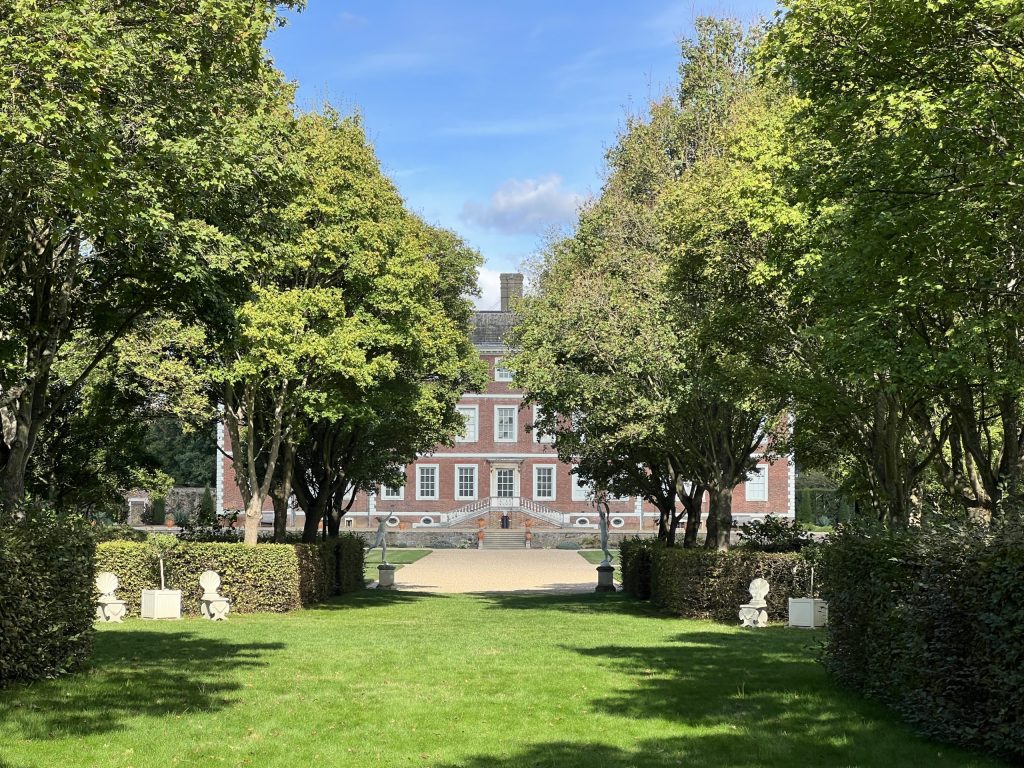
I’m excited to revive this blog as I enter the final year of my PhD project. In a series of posts, I will introduce my project, ‘Imagining Asia at Ham House, c.1672-1698. ‘ In this first entry, I’ll guide you through the fascinating setting of my project – Ham House.
Ham House is a location that is very familiar to me and known by many others, either encountered on a visit, as a backdrop to many films and TV shows, or as a critical case study in the works of three generations of art and furniture historians. As a freshly graduated twenty-one-year-old, I spent a season traipsing to the property by tram, train, and bus to help run the gift shop and steward rooms before starting my teacher training. Pitching introductions can, therefore, be complicated by this proximity; however, in this post, I will give a précis of Ham House as a property, its history, the significance of its collection, and the role of my PhD project in contributing to our understanding of this evocative place.

A privilege of research – alone in the Duke and Duchess’ suites
Nestled beside the Thames between Richmond and Kingston, Ham House remains an oasis of quiet in an urban landscape (though the still is punctuated every so often by planes approaching Heathrow). The politician and writer Horace Walpole was a regular visitor during the eighteenth century and described a dread sense that one might encounter the wraith of one of the home’s lauded Stuart inhabitants around each corner. Whilst Walpole’s gothic sensibilities may have exaggerated this sensation, on a quiet day with few visitors, the richly furnished rooms can give a sense that Ham’s former inhabitants have just vacated each room ahead of you.
As rightly described by the National Trust, it remains a seventeenth-century ‘treasure trove’, a place in which the veil between past and present feels thin and a snatch of the lost world of elite life in the reigns of Charles I and Charles II can be glimpsed. The property’s history makes this Sleeping Beauty quality even more remarkable, for Ham House is an exceptional survival.
It was built in 1610 in the Jacobean ‘H’ style for the courtier Sir Thomas Vavasour. In the 1630s, Ham House became the residence of Sir William Murray, his wife Catherine, and daughters Elizabeth, Katherine, Anne, and Margaret. Sir William had been part of the wave of Scottish courtiers who followed King James south and was a childhood companion of Charles I. As a member of the artistic circle around Charles I, Murray enhanced the estate by adding a new Great Stair, where Italian master copies were displayed. He commissioned the formation of the exquisite Italian-style Green Closet to showcase his collection of miniature paintings and had the Great Dining Room and North Drawing Room lavishly decorated.
Sir William and his family, however, only had a few years to enjoy their surroundings before, as loyal supporters of the crown, they and their home became embroiled in the turmoil of the Wars of Three Kingdoms and the Interregnum. With Sir William serving the King, the Murray women were left to balance their royalism with the possibility of parliamentary sequestration of their estates. Elizabeth made a politically expedient match with Sir Lionel Tollemache and cultivated a relationship with Cromwell and his daughters.

Though her letters from the period of the Interregnum protest that she wished for a peaceful life on her husband’s estates, she and her sisters maintained a connection to other royalists and the court in exile (the myths and legends surrounding Elizabeth’s and the Sealed Knot have been well analysed in Nadine Akkerman’s Invisible Agents). This loyalty was rewarded with an annual pension on the return of Charles II.
Nine years after the Restoration, Elizabeth was widowed, and in 1672, she formed half of a veritable Restoration-power couple when she married Charles II’s man in Scotland, John Maitland, Earl of Lauderdale. The match was not without rumour; Maitland had been a regular visitor to Ham House months after Sir Lionel Tollemache’s death; their wedding occurred not long after the death of Maitland’s first wife Anne in Paris. Gossip swirled, and a sustained enmity grew between Elizabeth and Maitland’s daughter Mary. By the 1800s, this had coalesced into a black legend and ghost story depicting Elizabeth as a poisoning murderess, using concoctions brewed in her Still House to kill both Sir Lionel Tollemache and Anne Maitland.
Regardless of this intrigue, the match of Elizabeth Murray and John Maitland was a well-made meeting of intellect, political ambition, and royal favour. Within a year of their wedding, the pair were raised to a Dukedom, and Ham House became a key base for the Lauderdales. It was a space where the Duke completed Scottish business on behalf of the king and where ambassadors, courtiers, and royals could be entertained in appropriate style by the couple.


In the wake of their wedding and rising fortunes, the Lauderdales embarked on a substantial refurbishment of Elizabeth’s childhood home. New enfilade suites of connected rooms were added to the South Front of the property. Completed between 1672 and 1675, they were to be used by the Duke, Duchess, and Queen Catherine of Bragança. The aligned corridors of these new courtly suites filled the voids of the property’s original Jacobean ‘H’ shape.
After the building works were completed, a significant refreshment of the property’s interiors was undertaken. Servants were tasked with sourcing fine furnishings in Amsterdam, Paris, and London. The tapestries and paintings of Elizabeth’s father were joined by rich new hangings of fringed silk and damask, beautifully crafted cabinets of ebony, ivory, and princewood, en suite matching furnishings of tables, torchères, and mirrors, and grand beds topped with cups and ostrich feathers.


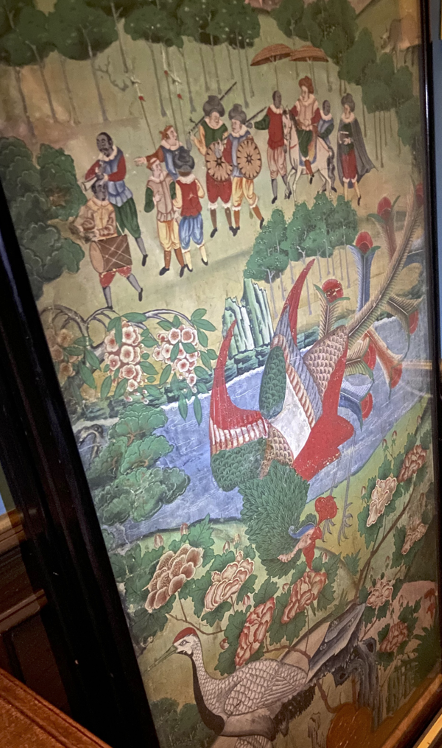
Left to Right: The Duke and Duchess of Lauderdale, a view along the South Front rooms from the Duchess’ Bedchamber to Duke’s Closet, a scritoire cabinet in the Duchess’ Closet, a New Spanish paper screen in an East Asian style displayed by the Duke and Duchess in the Queen’s Suite, images author’s own
Working with the surviving architecture and collections, art and furniture historians have characterised a Restoration Dutch and Francophile influence in the Lauderdales’ adaptations to the property in the 1670s and 1680s. This is where my project begins, for amidst these new furnishings were glimmering Japanese lacquer cabinets of pearl (raden) and gold (maki-e) work, monumentally sized Chinese kuan cai screens with Han Court and Bird and Flower scenes, Dutch paintings of Brazilian villages, cages for an array of extra-European birds, and torchères in which African and Indigenous American symbols were blended. The Lauderdales also commissioned early examples of chinoiserie furnishings – chairs, close stools, and cabinets – imitating East Asian materials and designs.

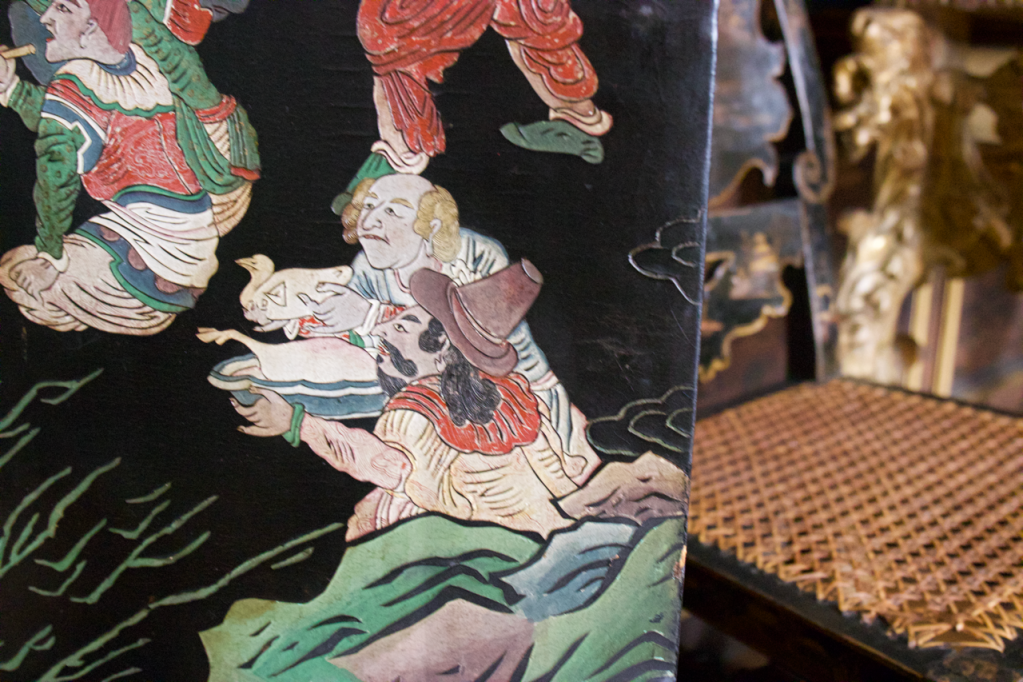


A taste of the global objects and material displayed by the Duke and Duchess: 1. Chinese kuan cai screen depicting Europeans hunting, a cabinet veneered in kuan cai, and chinoiserie backstool, 2. detail of Europeans depicted on a kuan cai screen, 3. detail of hunting figures on the veneered cabinet, 4. A chinoiserie backstool, 5. A New Spanish paper screen painted in Japanese Nanban style depicting a Portuguese trading delegation, Phoenix, and Crane, 5. a chinoiserie close stool.
The Duke and Duchess’s day-to-day life and their courtly entertaining were thus shaped by new furnishings, commodities, and materials resulting from a rapidly expanding world. My PhD project focuses on this proliferation of global, mainly Asian goods, that entered the property during the refurbishments of the 1670s and 1680s. By combining textual and object analysis, I have worked to build a picture of Ham House’s interiors during the Duke and Duchess’s reign and the place of these goods within the broader interiors of the property.
These objects and furnishings, I assert, represented new symbols of status in the reign of Charles II. They connected Ham House to an expanding world of trade and colonialism and a contemporary fascination with the societies of East Asia. In working with this rare collection, I am also building a picture of a neglected network of Carolean chinoiserie furniture makers and the male and female sellers of ‘India’ goods who supplied the Duke and Duchess. Through the gendered spaces of the Duke and Duchess’ suites and those of the Queen, I will also analyse how global goods and commodities shaped gendered courtly sociability (for example, the taking of tea or the wearing of the ‘Indian’ robe).
Though objects such as the Duchess’ fabulously exuberant chinoiserie backstools have been subject to scholarly analysis, this project represents one of the first whole-scale investigations into the presence of East Asian lacquers and other objects in the Duke and Duchess’ Restoration-era refurbishment of Ham House.
In the coming months, I will add summaries of my findings to this blog.
 Kerry Apps - History
You must be logged in to post a comment.